



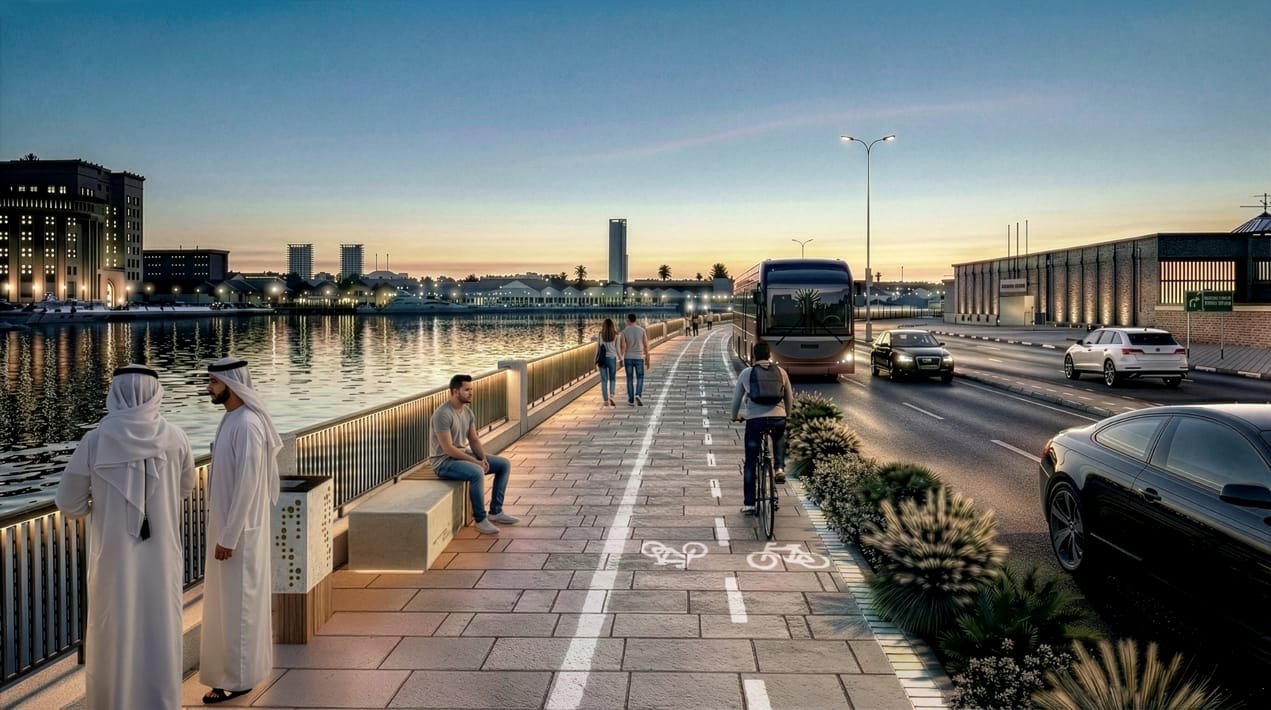
Dubai’s Roads and Transport Authority (RTA) has officially awarded the contract for Phase I of the Dubai Walk Master Plan in Al Ras. This initial phase focuses on the Historic Al Ras Walkway, covering 12 km of walkways and 5 km of cycling tracks. In addition, the project includes the rehabilitation of 10 artistic spaces in collaboration with the Dubai Culture and Arts Authority, featuring contributions from Emirati and local artists.
According to Mattar Al Tayer, the Director-General, Chairman of the Board of Executive Directors of the Roads and Transport Authority, “The Pedestrian Master Plan plays a key role in strengthening Dubai’s global competitiveness in walkway infrastructure and soft mobility. It also advances a key objective of the Dubai Urban Plan 2040 — the 20-minute city — by providing the infrastructure required to enable residents to access more than 80 percent of essential services within a 20-minute journey.”
The Master Plan is aligned with Dubai’s Quality of Life Strategy 2033, aiming to enhance community wellbeing by transforming Dubai into a more pedestrian-friendly city. It strives to raise pedestrian safety standards and strengthen connectivity among various districts and the existing network of walkways. Additionally, the plan integrates creative, aesthetic, and cultural dimensions into soft mobility components, reinforces the distinctive identity of urban areas, and enhances the emirate’s visual landscape while contributing to the beautification of public spaces.
Further, Al Tayer noted, “It further strengthens collaboration with strategic partners in advancing creative elements within mobility infrastructure and facilities, while empowering youth and reflecting future mobility trends through their engagement in proposing innovative concepts for the design of walkways and associated amenities.”
The Dubai Walk Pedestrian Master Plan envisions a comprehensive framework for an integrated, accessible walkway network that maintains high safety standards and ensures a comfortable experience for pedestrians. The long-term rollout will see the development of infrastructure across 160 areas, resulting in 6,000 km of walkways by 2040. The plan also includes the construction of 110 pedestrian bridges and underpasses to enhance connectivity, with the goal of boosting the share of walking and soft mobility trips from 16 percent in 2025 to 25 percent by 2040.
Team V.4-EM-UAE